WZ Dobermans: what the Z-list means
Updated November 2026 · By Owego Dobermans
If you've seen "WZ" at the start of a Doberman's registration number, you may have also read that WZ dogs should be avoided. The real picture is more nuanced. Here's what the designation means, where the concern comes from, and how DNA testing changes things.
What a WZ number means
In 1976, two black and rust Dobermans produced a white female, Padula's Queen Sheba. She was later bred to produce more white Dobermans (AKC). White Dobermans have a form of albinism caused by a recessive gene. A dog needs two copies, one from each parent, to be white. Dogs with one copy look completely normal.
Because carriers can't be spotted by eye, the Doberman Pinscher Club of America asked the AKC to flag the line. In 1996 the AKC agreed to give every descendant of Sheba's sire or dam a registration number starting with "WZ," whatever its color (Winkler et al., PLOS ONE). This is the "Z-list," and it now includes more than 20,000 Dobermans (AKC).
What WZ doesn't tell you
The 2014 study that found the albinism gene put it plainly: the WZ number "does not provide an indication of the actual carrier or non-carrier status of the dog" (Winkler et al., PLOS ONE). A WZ dog may not carry the gene at all, and a dog without WZ isn't proven clear. Only a DNA test shows what a dog carries. The same study found two carriers among the normally colored Dobermans it tested.
In other words, WZ is a family-tree flag. It was created before a DNA test existed, as the best tool breeders had at the time.
Why the breed club tracks it
The concern is about white puppies, not normally colored ones. White Dobermans are sensitive to bright light and have far more skin growths with age. In the 2014 study, 12 of 20 white Dobermans had skin tumors, compared with 1 of 20 standard-colored Dobermans (Winkler et al., PLOS ONE). The AKC notes that most albino dogs still live a normal lifespan but need extra sun protection and care (AKC).
Avoiding white puppies is the goal. With today's DNA test, a breeder can meet that goal directly instead of relying on the pedigree.
How DNA testing changes the picture
Since 2014, a cheek-swab test can read the exact gene behind Doberman albinism (AKC). The UC Davis Veterinary Genetics Laboratory reports three results (UC Davis):
| Result | What it means | What the dog passes on |
|---|---|---|
| N/N (clear) | No copy of the gene | Can't pass it to any puppy |
| N/OCA (carrier) | One copy; normal color and normal coat | Passes it to about half its puppies |
| OCA/OCA | Two copies; white (albino) | Passes it to every puppy |
A white puppy needs a copy from both parents. So if even one parent tests N/N, no puppy in the litter can be white. Breeding two carriers is the only pairing of normally colored dogs that can produce white puppies, at about 1 in 4 (UC Davis).
The test reads the Doberman albinism gene specifically. It isn't a full guarantee against every rare pigment mutation, but it covers the one behind white Dobermans.
Why a WZ Doberman may not be a problem
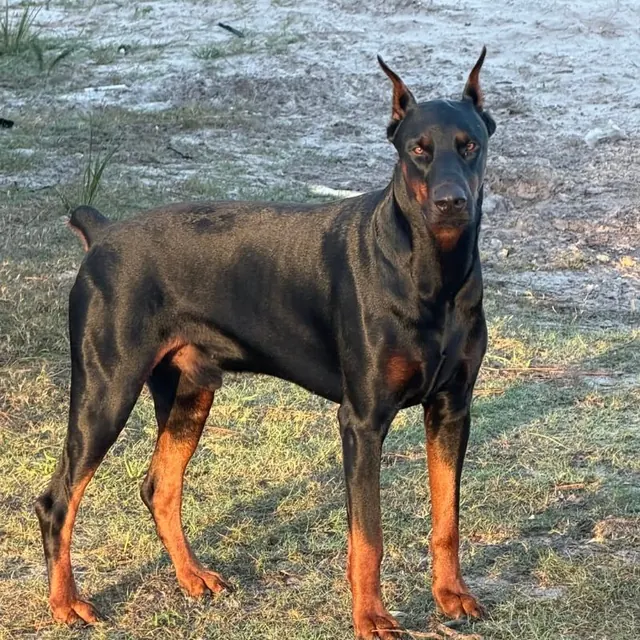
- It's a normal Doberman. A black, red, blue or fawn WZ dog isn't albino and has the same coat, eyes and skin as any other Doberman of its color.
- It's fully purebred and AKC-registered. The AKC investigated the line and found it purebred (DPCA).
- The real risk can be tested. A DNA report on both parents tells you what the letters can't. With at least one clear parent, white puppies aren't possible.
- Your puppy's own result is knowable. If you want certainty for future plans, your puppy can be tested too.
- The rest of the health picture is the same. Heart disease, vWD, hips and eyes matter just as much in a WZ dog as in any Doberman. See our health testing guide.
The honest downsides
- The breed club opposes breeding WZ dogs. The DPCA says any Doberman with a WZ number "should not be bred" (DPCA puppy flier). Some breeders and buyers follow that rule strictly.
- The letters are permanent. WZ stays on the papers of every descendant, even when DNA tests come back clear. That can matter if you ever plan to breed your dog or hand it on.
- A clear result covers one gene. It rules out the known Doberman albinism gene, not every possible pigment mutation.
- A WZ number with no DNA results is a question mark. Without test results, you only know the pedigree, not what the parents carry.
Questions to ask about a WZ litter
- Do you have the OCA (albinism) DNA results for both parents? Can I see the lab reports?
- Is at least one parent N/N (clear)?
- What other health tests do the parents have: heart screening, vWD, DCM DNA, hips and eyes?
- Will my puppy come with full or limited AKC registration?
- Will you include copies of the parents' DNA reports with the puppy's papers?
A breeder who has tested will be glad to show you. If the answer is "the WZ doesn't matter" with no results to back it up, keep asking.
Frequently asked questions
Is a WZ Doberman purebred?
Yes. When the breed club asked the AKC to investigate the first white Doberman, the AKC determined the line is purebred. WZ dogs are fully AKC-registered Doberman Pinschers.
Can a black and rust WZ Doberman have white puppies?
Only if it carries the albinism gene and is bred to another carrier. A DNA test of both parents answers this before the litter is planned. If either parent tests clear (N/N), no puppy in the litter can be white.
Will my puppy's papers say WZ even if the parents test clear?
Yes. The AKC assigns the WZ prefix to every descendant of Sheba's parents, based on the pedigree. A clear DNA result doesn't remove it, so keep a copy of the parents' DNA reports with your puppy's papers.
Does WZ affect health or temperament?
The WZ prefix itself says nothing about a dog's health or personality. Judge a WZ puppy the way you would any Doberman: the parents' health testing (heart, vWD, hips and eyes), their temperament, and how the litter is raised.